‘Lads’ Mags’, Young Men’s Attitudes
towards Women and Acceptance of Myths about Sexual Aggression - Maddy COY and
Miranda A.H. HORVATH
For example, in the UK a 2007 Ofsted1 report suggested that
‘while at time sreinforcing sexist attitudes’ lads’ mags provide a positive
source of information for young people (OFSTED, 2007), suggesting that the
potential negative effects of lads’ mags are minimal and not a cause for
concern.
Labour Member of Parliament (MP) Claire Curtis-Thomas
presented a Bill to Parliament in 2006 attempting to restrict their display in
shops, and Conservative party leader David Cameron has expressed concern over
lads’ mags fuelling a culture of youth violence.
LADS’ MAGS AS A GENRE
In this commentary we use the term ‘lads’ mags’ to reflect
our focus on UK-based titles Loaded, Nuts, Zoo and FHM (For Him Magazine). While
some lads’ mags titles are available in Australia (for example RALPH, Zoo and
FHM), Thailand and Scandinavia (Monkey), they appear to be primarily a UK and
US media phenomenon. They are popular and accessible media sources in
contemporary youth culture, and constitute a key element of what is often
referred to as the ‘sexualization of popular culture’ (see Gill, 2007, 2008;
Levy, 2005). Content is typified by notions that Rosalind Gill (2007) defines
as a post-feminist media sensibility characterized by an idea that women can
use their bodies for profit as Page 1
All types of men’s lifestyle magazines are relatively new.
As Rogers identifies ‘in the mid-1980s, publishers were doubtful about the
possibility of introducing a formula to unite men’s interests’ (2005: 179).
However in the early 1990s Loaded (launched in the UK in 1994), signalled the
advent of a new genre in lifestyle magazines aimed at young men. Subsequent
publications such as Nuts and Zoo have combined circulation figures of
approximately half a million copies every week with a target readership of
18–30 year olds (Turner, 2005). In the USA, the leading men’s magazine, Maxim,
has a circulation of nearly 2.5 million (Karges,2005). Page 2
While in the UK the term ‘lads’ mags’ differentiates the
style and content from previously existing men’s lifestyle magazines, even
these demarcations have become blurred; as Benwell (2004) points out, the
launch of lads’ mags has led to the ‘older’ generation of men’s magazines
shifting their content towards increasing sexualization. Magazines such as GQ
and Esquire that were positioned as ‘upmarket’ have become more reliant on
‘babes and boobs’ and a more hedonistic, predatory construction of masculinity
(Stevenson et al., 2003: 121) Page 2
First, the widespread acceptance and availability of lads’
mags in the UK introduces them to generations of boys and young men. This is of
particular note given that boys and young men are a group for whom sources of
information about sexuality are particularly limited (Buckingham and Bragg,
2002). Research demonstrates that young people, particularly boys, who are
exposed to sexualized media are likely to perceive women to be sex objects
(Peter and Valkenburg, 2007). Evidence also shows that sexualized representations
of girls and women lead to negative personal and social outcomes for girls and
women, such as damage to body image, sense of self, diminished educational
aspiration and achievement, and pressure to conform to young men’s expectations
of sexual availability (see American Psychological Association, 2007; Coy, in
press). For feminist researchers, this sharpens the call to examine how men’s
attitudes and behaviours are influenced as a result of consuming a ‘sexy diet’.
(Brown et al. , 2006) Page 2
The report surveyed sixth-form students (17–18 years old)
and found that all the girls who viewed Zoo and Nuts were angry, offended or
upset by the images of women (Jakubowicz and McClelland, 2008). Similarly, in
the USA, Walmart stopped selling Maxim, Stuff and FHM in 2003 on the basis that
shoppers were offended by the sexualized imagery of women on the covers (Carr
and Hayes, 2003). Page 3
We contend, however, that the centrality of sexualized
imagery may influence attitudes to women in harmful ways, and thus cannot be
defended as harmless entertainment.
Page 3
Content analysis of lads’ mags demonstrates that the
prominent themes are of female nudity and self-centred sexual pleasure seeking
(Krassas et al., 2003; Object, 2006; Taylor, 2005), limiting representation of
women to ‘the reductively sexual’ (Tincknell et al., 2003). For instance,
issues of UK-based publication Nuts typically feature over 70 images of women,
with a third topless (Turner, 2005).
Page 3
Research with men exposed to images of women in advertising
by Lanis and Covell (1995) found them to be significantly more accepting of
rape-supportive attitudes where women are depicted as ‘sex objects’ rather than
in ‘progressive roles’. Page 4
Postfeminist Media Culture: Elements
of a Sensibility
Where once sexualised representations of women in the media
presented them as passive, mute objects of an assumed male gaze, today
sexualisation works somewhat differently in many domains. Women are
not straightforwardly objectified but are presented as active, desiring
sexual subjects who choose to present themselves in a seemingly objectified
manner because it suits their liberated interests to do so (Goldman, 1992)
page 8
.Nowhere is this clearer than in advertising which has
responded to feminist critiques by constructing a new figure to sell to
young women: the sexually autonomous heterosexual young woman who plays
with her sexual power and is forever 'up for it'. page 8
'Once porn and real human sexuality were distinguishable.
Not even porn's biggest advocates would suggest a porn flick
depicted reality, that women were gagging for sex 24/7 and would drop
their clothes and submit to rough, anonymous sex at the slightest
invitation. But as porn has seeped into mainstream culture, the line
has blurred. To speak to men's magazine editors, it is clear they
believe that somehow in recent years, porn has come true. The
sexually liberated modern woman turns out to resemble -- what do you know!
-- the pneumatic, take-me-now-big-boy fuck-puppet of male fantasy
after all.'(Turner,
2005: 2) page 9
TV presenter Denise van Outen 'confides' in a TV interview,
"I do have a lovely pair. I hope they'll still be photographing
my tits when I'm 60"; 'readers wives' write in to lad magazines with
their favourite sexual experiences e.g. "he turned me around, bent me
over the railings and took me from behind, hard"; and girls
and women in the west queue up to buy T-shirts with slogans such
as 'porn star', 'fcuk me' and 'fit chick unbelievable knockers'.
page 9
Magazines like Heat offer page after page of big colour
photographs of female celebrities’ bodies, with scathing comments about
anything from armpit hair to visible panty lines, but focusing in
particular upon 'fat' and more recently in the censure that greets women
deemed to be ‘too thin’. So excessive and punitive is the regulation
of women's bodies through this medium that conventionally attractive women
can be indicted for having 'fat ankles' or 'laughter lines'. Page 5 + 6
Instead of caring or nurturing or motherhood being regarded as
central to femininity (all of course, highly problematic and exclusionary) in
todays media it is possession of a ‘sexy body’ that is presented as women’s key
(if not sole) source of identity. 5
By sexualisation I refer to both the extraordinary proliferation
of discourses about sex and sexuality across all media forms, referred to by
Brian McNair (2002) Page 7
Newspapers’ use of rape stories as part of a package of
titillating material is well documented, and in news media all women’s bodies
are available to be coded sexually – whether they are politicians, foreign
correspondents or serious news anchors. Page 7
In the ‘lads mags’ sex is discussed through a vocabulary of
youthful, unselfconscious pleasure seeking 7
Men, by contrast, are hailed by the lad mags as hedonists just
‘wanting a shag’. The uneven distribution of these discourses of sex, even in a
resolutely heterosexual context, is crucial to understanding sexualisation
(Tincknell et al, 2003; Gill, 2006).
‘Porno chic’ has become a dominat represemtational practice in
advertising, magazines, Internet sites and cable television. Even children’s
television has adopted a sexualised address to its audience and between its
presneters. The commercially driven nature of this sexualisation can be seen in
the way that clothing companies target girls as young as 5 with thongs (G
strings), belly tops, and t-shirts bearing sexually provocative slogans e.g.
‘when I’m bad very, very bad, but when I’m in bed I’m better’. Page 8
A key feature of the postfeminist sensibility has been the
resurgence of ideas of natural sexual difference across all media from
newspapers, to advertising, to talk shows and popular fiction. Page 17
Milkshakes, Lady Lumps and Growing Up to Want Boobies: How the Sexualisation of Popular Culture Limits Girls’ Horizons
The term ‘sexualisation of culture’ describes the current saturation of erotic imagery, particularly of women, in popular culture, for example, advertising and music videos (Gill, 2007; Levy,2005). page 2
Images of women's sexuality in advertisements: a content analysis of Black- and White-oriented women's and men's magazines.
Women are still shown primarily in submissive positions and as sex objects. Sexual women are often used in advertisements for men to imply a sexual relationship between the man who uses the product and the woman in the advertisement. Sexual women are also used in advertisements for women to imply that the product will increase the user's appeal to men (Courtney & Whipple, 1983).
There are now more media outlets for various audiences, and advertisers increasingly target certain groups. However, in a patriarchal society, the image of sexuality that is presented to all people is highly influenced by a heterosexual man's perspective. From this perspective, sexual attractiveness in women is associated with physical beauty. A sign of status for a man is to have a physically attractive woman by his side. The more physically attractive a woman is, the more prestige she will bring to her male partner/spouse (Renzetti & Curran, 1999).
It has been suggested that media that target women are more likely to portray women in a way that reflects reality, and thus should be more responsive to the changing situation of women in society than media that target men and women, or only men (Strinati, 1995). However, researchers have shown that women are still often shown as sex objects in media designed specifically for women, which implies that advertisers believe that women accept an objectified and passive view of themselves (Courtney & Whipple, 1983).
Empowerment/Sexism: Figuring Female Sexual Agency in Contemporary Advertising
http://facweb.northseattle.edu/avoorhies/Gender/Readings/Culture/Figuring%20Female%20Sexual%20Agency%20in%20Contemporary%20Advertising.pdf
Gill, R. (2008) ‘Empowerment/Sexism: Figuring Female Sexual Agency in Contemporary
Advertising’, Feminism & Psychology 18:
This has become almost ubiquitous in affluent developed societies understood as being in a ‘postfeminist’ moment, in which women are invited to purchase everything from bras to coffee as signs of their power and independence (from men). p36
The use of sex as a means of selling is probably as old as advertising itself and advertising has long been indicted for contributing to the silencing of women’s desire by presenting women primarily as objects for male consumption and pleasure (e.g. Cortese, 1999; Dyer, 1982; Goffman, 1979; Jhally, 1987; Kilbourne, 1999; Myers, 1986; Williamson, 1978). p38
However, in recent years, advertising has begun to move away from depictions of women as straightforward objects of the male gaze, and there is a new emphasis in some adverts upon women’s sexual agency (Gill, 2003; Goldman, 1992; Macdonald, 1995; Winship, 2000), particularly in ads for products targeted at young women. p38
Discourses of women’s desire, far from being silenced, seem to be everywhere: in magazines promising
better, hotter sex, in the proliferation of self-help guides and memoirs such as ‘How to Make Love Like a Porn Star’ (Jameson, 2003) or ‘Girl with a One Track Mind’ (Lee, 2006) p39
in the figures of raunchy female pop stars who borrow from the codes of pornography in their self-presentation, e.g. Christina Aguilera’s ‘Dirrty’ and ‘Stripped’, and at the heart of celebrity culture in which tales of sexy secrets and ‘filthy’ fantasies are everywhere. p39
Advertising has changed constantly throughout its history, in response to changes in the economy, technology, fashion and social relations. But the shiftsvthat it has undergone in the last two decades have been particularly significant, as developments in information and communication technologies, the emergence of a new generation raised on computer games and music television, and the growing confidence of increasingly ‘media-savvy’ consumers forced a radical rethink of previous advertising strategies. p39
One of the most significant shifts in advertising in the last decade or more has been the construction of a new figure: a young, attractive, heterosexual woman who knowingly and deliberately plays with her sexual power and is always ‘up for it’ (that is, sex). p41
This figure has become known in some advertising circles as the ‘midriff’, named after the fashion for exposing this part of the body (often to reveal pierced belly button and a tattoo on the lower back) p41
Midriff advertising has four central themes: an emphasis upon the body, a shift from
objectification to sexual subjectification, a pronounced discourse of choice and autonomy, and an emphasis upon empowerment. p41
Today, the body is portrayed in advertising and many other parts of the media as the primary source of women’s capital. p42
Instead of caring or nurturing or motherhood (all of course highly problematic and exclusionary), it is now possession of a ‘sexy body’ that is presented as women’s key source of identity. p42
This is captured vividly in an advert for Wonderbra® that shows a young woman wearing only a black, cleavage-enhancing bra. Situated between the breasts is the following slogan: ‘I can’t cook. Who cares?’ – making the point that her voluptuous body is far more important than any other feminine skills or attributes she may or may
not possess. p42
There has also been a shift in the manner that women’s bodies are presented erotically. Where once sexualized representations of women in the media presented them as passive, mute objects of an assumed male gaze, today women are presented as active, desiring sexual subjects who choose to present themselves in a seemingly objectified manner because it suits their (implicitly ‘liberated’) interests to do so. p42
A crucial aspect of both the obsessional preoccupation with the body and the
shift from objectification to sexual subjectification is that this is framed in advertising through a discourse of playfulness, freedom and, above all, choice. p42
Not only are women objectified (as they were before), but through sexual subjectification in midriff advertising they must also now understand their own objectification as pleasurable and self-chosen. If, in earlier regimes of advertising, women were presented as sexual objects, then this was understood as something being done to women (from the outside) by a sexist advertising industry – something that many people began to realize and critique through the impact of feminist activism. In contemporary midriff advertising, however, (some) women are endowed with the status of active subjecthood so that they can ‘choose’ to become sex objects. p45-46
Supersexualize Me! Advertising and ‘the midriffs’ - Rosalind Gill
The midriff is a part of the body between the top of the pubis bone and the bottom of
the rib cage. - Page 5
In one sense it signals a generation -primarily women in their 20s and 30s, but sometimes also girls in their teens and women in their early 40s -- defined by their fashion tastes. More tellingly, however, the midriffs could be understood less in age terms than in relation to a particular sensibility: a sensibility characterised by a specific constellation of attitudes towards the body, sexual expression and gender
relations - Page 5
In today's midriff advertising women are much less likely to be shown as passive sexual objects than as empowered, heterosexually desiring sexual subjects, operating playfully in a sexual marketplace that is presented as egalitarian or actually favourable to women. Page 5-6
http://books.google.co.uk/books?id=tpW22FvYvn8C&pg=PA185&lpg=PA185&dq=lynx+target+audience&source=bl&ots=HdrNGri_fm&sig=vuXEyZmAAZBn38d16xpptMjqJ6M&hl=en&sa=X&ei=xtgHUfT7FYWa1AXbnIDwBA&ved=0CEYQ6AEwAQ#v=onepage&q=target%20audience&f=false
Strategic Market Management: Global Perspectives
By Damien McLoughlin, David A. Aaker
In 1990 Lynx was used by 32.7% of 15-19 year olds, in 1996 by 72.1% and in 2001 by 81.5%, in each different cohort os users and in each case a very high level of penetration.
Moving Image Research
Lynx clean your balls menswear advert
·
From official youtube channel
·
Posted Nov 14, 2012-11-25
-
Lynx spokesperson addressing clean your balls campaign
-
Big boobed journalists – sexually objectifying, voyeuristic view,
-
Sexual innuendos of balls – double ontundra
-
“Jump right on it”
Lynx Manwasher – Clean your balls
·
Posted Nov 1 2012
·
Official youtube channel
- Broadcast demonstration + seller
- Sexual innuendos
- ‘Amber James’ – tennis champion
-
No bra
-
Sexually objectifying
-
Kissing cup, mirror?
-
White – purity/viriginity
Lynx 2012 – Get it on for the end of the world
·
Posted Oct 26 2012
-
Mose’s arch
-
Spray deodorant: women come out 2x2
-
Voyersitic shot – womens bum in short shorts
-
Wearing provocative clothes – Shows lots of cleavage + flesh
-
Women look ‘up for it’
Lynx Dry: Premature perspiration tv ad
- Sexual Connotations of 'premature perspiration'
- Sexualising women - making them seem like objects
- Women = 2nd class citizens
Lynx rise advert
- Women bending over: Voyeristic view and objectifying women
- Big breasted blonde - stereotype: ditsy/dumb
- Women in lingerie throughout: Constantly sexually available, objectifying women
- Woman in bra: 'up for it', talking about sexual desires/performance
- Reverting roles: Man cooking
- Breasts/cleavage constantly on display: sexually available, objectifying
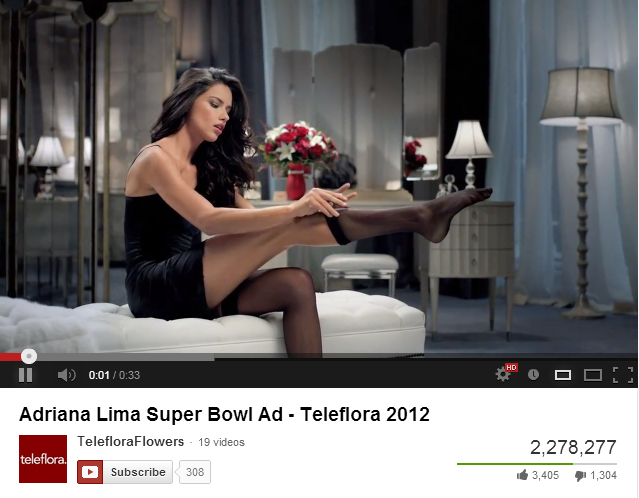
Teleflora 2012 superbowl advert
- Adriana Lima: Victoria secret model, star power
- Sexual poses
- "Valentines night": sex?
- Superbowl: family audience
- Promoting sexual availability
- Lingerie
- Getting dressed = voyeristic view
- Give and you shall receive: oral sex?
Kingsmill fruit & fibre bread
- Sexualising young female: short skirt, school girl fantasy?
- Criticised for sexualising an everyday product
- Investigation into it by ASA
- 18 year old actress
- Depicting real life?
Janice Turner Dirty Young Men
http://www.guardian.co.uk/theguardian/2005/oct/22/weekend7.weekend3
The lads' mags appear more influenced by pornography in the poses their models strike, their obsession with girl-on-girl action, and their use of soft-porn staples such as women writing in with "real life" sexual adventures: "He turned me around, bent me over the railings and took me from behind."
Into this vacuum of ironic acceptance swept a whole plethora of sexual imagery. Nuts and Zoo are just one manifestation - along with cable stations, advertising, internet sites and Big Brother's sexual shenanigans - of how pornography has invaded mainstream culture.
Once porn and real human sexuality were distinguishable. Not even porn's biggest advocates would suggest a porn flick depicted reality, that women were gagging for sex 24/7 and would drop their clothes and submit to rough, anonymous sex at the slightest invitation.
But as porn has seeped into mainstream culture, the line has blurred. To speak to men's magazine editors, it is clear they believe that somehow in recent years, porn has come true.
"You are imposing outmoded sexual politics on a world that doesn't fit any more." Women are gagging to appear in Nuts: hundreds send in their pictures, seeing it as empowering, sexy, a celebration of their youthful good looks.
"Men can get sexy images from the web, cable TV, DVDs. They want something extra. Sex has been completely watered down. Sex is everywhere."
Images of women in advertisements:
effects on attitudes related to sexual aggression
Sex and Violence in Advertising: How
Commodifying and Sexualizing Women Leads to Gender Violence - Shana Meganck


 One of the other women are drinking the drink, and looking up also in the same direction. The women has flawless skin, and green eyes. This is something that other women might aspire to have. The look up is also one of anticipation.
 As the man comes down through the roof of the elevator, the audience are initially shown the mans body. We are given a view which we are led to believe is the women's view. As he descends into the camera shot, we are given a medium shot of his midriff. The male protagonists top rises up exposing his stomach, which shows his abs. This is supposed to be appealing to the female audience, as they get the visual pleasures associated with a young physically fit young man.
 The male protagonist's face is finally exposed, and the audience are given a view of his face. The camera is still in the view of the female actors, and the audience still have their point of view. The male protagonist doesn't speak, and is just a passive object that is there for visual pleasure purposes. Just a sexualised object.


 The male protagonist in the advert is shown taking off his shirt in a high angle shot, which is probably the view that the women have. However, this type of shot makes the subject smaller, and seem inferior whilst at the same time making the viewer the higher power in the scene. This will be a popular type of shot amongst the females whilst they are sexualising this male because it is reversing the role in society that was popular then; that men are dominant in almost every field and women are second class.